















Solutions


Attract new customers to your brand
Leverage our affiliate network to reach new customers for your products and services. Search for relevant affiliates and partners with engaged audiences who are in-market and ready to buy. Our global network enables you to promote your brands to millions of customers.
Plans & Service
Plans & Service
Discover our range of Platform Plans & Service Plans to unlock the technology & service behind our premium partnership marketing campaigns. Explore to grow your sales and improve your performance.
Partners

Partner Types
Partners
Discover why Optimise is the affiliate network & partnerships platform of choice for so many Partners. Explore the Advertiser Directory to create new relationships, grow your network and leverage our extensive range of partner tools.
Advertisers

Advertisers
Reach across our extensive network of Marketplaces and learn why global advertisers work with our network of quality publishers. Explore our Partner Platform technology & Service Plans backed by our team of local experts.

7 Proven Strategies to Scale Affiliate Marketing Effectively
7 Proven Strategies to Scale Affiliate Marketing Effectively
7 Proven Strategies to Scale Affiliate Marketing Effectively
More than 80% of brands now use affiliate marketing as a core customer acquisition and revenue channel (Hostinger), yet many brands are only scratching the surface of what this channel can deliver. The real question isn't whether to invest in affiliate marketing. It's how to scale affiliate marketing in a way that is sustainable, measurable, and genuinely profitable.
The appeal is easy to understand. Affiliate marketing is fundamentally performance-based. You pay for results (clicks, leads, and sales) which makes it one of the lowest-risk channels in a brand's marketing mix. But low risk doesn't always translate to high scale.
Many advertisers launch a programme, recruit a handful of partners, generate some early wins, and then plateau. Growth stalls. The same partners drive the same volume. Commission structures become stale. Data sits in dashboards nobody acts on. Global growth remains an untapped and distant ambition.
If that sounds familiar, this article is for you.
We'll share 7 proven strategies for scaling affiliate marketing — from building a diverse partner ecosystem and optimising commissions, to leveraging data, automating programme management, and expanding into new markets. We'll also show how a platform like Optimise can support each stage of that journey.
Why Scaling Affiliate Marketing Is Harder Than Starting It
Starting an affiliate programme is relatively straightforward. A brand joins a network, onboards a few trusted partners, and begins generating conversions. Early momentum can be encouraging. But sustaining and growing that momentum is an entirely different challenge.
Several factors can cause programmes to plateau:
- Over-reliance on a small group of partners, leaving the programme exposed when those partners change priorities
- Flat, inflexible commission structures that fail to incentivise partners to promote new or high-margin products
- Limited tracking and attribution insight, meaning brands cannot identify which partners or touchpoints are driving real value
- Manual programme management, which creates bottlenecks as campaign complexity increases
- A domestic-only focus, missing the growth potential that international markets can offer
According to industry research, the global affiliate marketing industry is projected to reach $36.9 billion by 2030, growing at a compound annual rate of over 10 (affiliatestatistics.marketing). The brands capturing that growth are those that invest in the ability to scale from the outset — diversified partners, smart incentives, and robust technology.
Understanding these barriers is the first step. The strategies below address each of them directly.
7 Proven Strategies for Scaling Affiliate Marketing
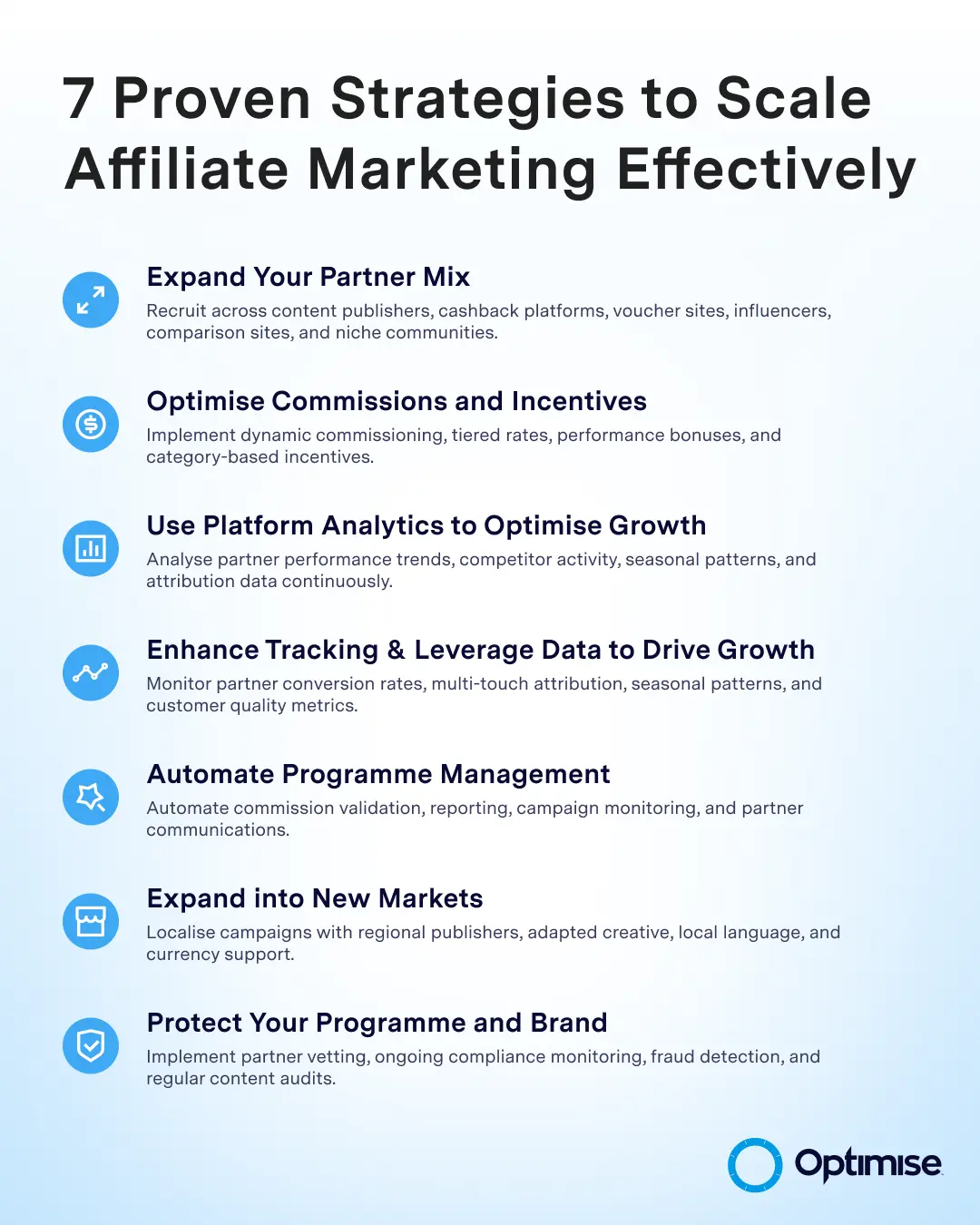
1. Expand Your Partner Ecosystem Strategically
Scaling Challenge
Too much reliance on one type of publisher can restrict programme growth and reduce opportunities to reach new audiences at different stages of the buying journey.
Strategic Solution
One of the most important things a brand can do to scale affiliate marketing is to diversify its partner mix. Most programmes already work with cashback, voucher, and comparison sites. While these partners are valuable, they predominantly operate at the bottom of the funnel, focusing on deal-driven, price-sensitive customers close to the point of purchase.
Sustainable growth requires a broader ecosystem. The partner types that are most commonly underutilised and can unlock significant incremental value are:
- Content publishers: Blogs, editorial sites, and review platforms that drive intent-led traffic earlier in the customer journey
- Influencers and creators: Valuable for audience discovery, brand awareness, and reaching new customer segments
- Technology partners: Including on-site optimisation tools, email platforms, and data providers that enhance conversion across the funnel
- Brand-to-brand partners: Collaborations with complementary brands that open access to established, relevant audiences
A well-diversified partner ecosystem means your programme is not vulnerable to the decisions of any single publisher. It also means your brand is visible to customers across multiple touchpoints and purchase triggers.
How Optimise Enables It
The Optimise Partner Platform gives advertisers access to a global network spanning retail, travel, finance, technology, and beyond. One of its key features is the Opportunities Dashboard, an AI-driven tool that automatically surfaces and ranks partner opportunities based on relevance to your brand and campaign goals.
Rather than manually prospecting, advertisers are presented with the most relevant partners first, making discovery faster and more strategic across 25,000+ partners worldwide.
2. Reward High-Performing Partners with Dynamic Commission Structures
Scaling Challenge
Rigid commission structures limit growth by failing to appeal to top-performing partners. They also erode ROI as partner motivation is not aligned with high-value campaign objectives.
Strategic Solution
Commission structure is the most powerful levers in affiliate marketing — and one of the most commonly mismanaged. A flat, one-size-fits-all rate may be simple to administer, but it doesn't reflect the complexity of modern businesses and what drives profitability.
To scale effectively, advertisers should consider implementing dynamic commissioning, where rates are aligned to value criteria, such as new or existing customers, product , or campaign period. Strucutres can include;
- Category-based rates: Higher commissions for high-margin products, lower rates for commodity items
- Tiered commission structures: Rewarding partners who drive greater volume or higher-value orders with increased rates
- Performance bonuses: One-off incentives for hitting specific milestones or during promotional pushes
The principle is straightforward: Commission structures should align partner motivation with business objectives. If you want partners to prioritise your premium products, or surplus stock, your commission model should reflect that.
How Optimise Enables It
Optimise's Dynamic Commissioning tools allow advertisers to adjust commission rates based on granular factors including partner performance , product category, order value, or even SKU. This level of flexibility helps maximise return on investment whilst encouraging partners to focus their promotional efforts where it matters most.
3. Leverage Data and Tracking to Drive Growth
Scaling Challenge
Without reliable tracking and performance data, it is difficult to identify which partners are genuinely driving value, which campaigns are working, and where budget should be deployed next.
Strategic Solution
Data is the engine of affiliate programme growth. Brands that scale successfully are not doing so by instinct — they are acting on clear, reliable performance insight.
Effective data and tracking practices include:
- Monitoring individual partner conversion rates, not just click volume
- Understanding multi-touch attribution to see how affiliate partners contribute across the customer journey
- Identifying seasonal and behavioural patterns that inform campaign timing
- Tracking customer quality indicators such as return rates, repeat purchase behaviour, and average order value by partner
This level of insight allows brands to allocate budget more precisely, reward high-performing partners appropriately, and phase out relationships that are generating clicks but not conversions.
How Optimise Enables It
The Optimise Partnership Platform provides robust tracking and reporting dashboards featuring cross-device attribution, conversion path analytics, and campaign performance data. These tools help advertisers make fast, confident, data-driven decisions — identifying what's working, what isn't, and where the next growth opportunity lies.
4. Automate Programme Management
Scaling Challenge
Manual processes create operational bottlenecks as a programme grows. The administrative burden of validating commissions, managing communications, and monitoring campaigns can slow growth and introduce errors.
Strategic Solution
Automation is not a shortcut but a prerequisite for scale. As affiliate programmes grow in complexity, the operational demands increase significantly. Automation frees up programme managers to focus on strategic decisions rather than administrative tasks.
Key areas where automation adds value:
- Commission validation and approval workflows: Reducing manual review time and error
- Automated reporting and performance alerts: Enabling faster response to campaign changes
- Partner communication and onboarding: Ensuring consistent experience at scale
- Fraud and compliance monitoring: Flagging anomalies without manual oversight
The goal is a programme that can grow in scale and complexity without requiring a proportional increase in resource.
How Optimise Enables It
Optimise offers automation tools including commission validation workflows, automated reporting integrations, and campaign monitoring systems. Combined with dedicated account management support, these tools allow advertisers to manage large, complex programmes efficiently.
5. Expand into New Markets
Scaling Challenge
Many affiliate programmes struggle to scale internationally due to differences in language, local publisher ecosystems, currency requirements, and regional consumer behaviour.
Strategic Solution
International expansion is one of the most significant growth levers available to established affiliate programmes. Yet it is frequently underutilised, often because brands underestimate the complexity of localisation.
A successful international affiliate strategy involves more than translating campaign creative. It requires:
- Building relationships with regional publishers who understand local audiences
- Adapting commission structures to reflect local market dynamics and partner expectations
- Tailoring creative and messaging to local language, culture, and consumer behaviour
- Supporting local currency and payment requirements
- Understanding regional compliance and regulatory requirements
Brands that approach international expansion with a localisation-first mindset consistently outperform those that simply replicate their domestic strategy in new markets.
How Optimise Enables It
With local teams and offices across Southeast Asia, India, the Middle East and North Africa, Australia, and the United Kingdom, Optimise provides genuine regional expertise. Advertisers benefit from established local publisher relationships, regional knowledge, and full support for currency and language requirements.
A leading regional travel experiences platform partnered with Optimise to manage its affiliate programme across Southeast Asia, Hong Kong, and Taiwan. The results were significant: Optimise delivered a year-on-year increase in overall Gross Merchandise Value (GMV) of +45%, demonstrating the clear commercial return of a genuinely localised, regionally managed affiliate strategy.
6. Protect Your Programme and Brand
Scaling Challenge
As affiliate programmes grow, so does exposure to risk. Fraudulent traffic, policy violations, and brand misuse can waste marketing budget and damage brand reputation.
Strategic Solution
Brands that fail to implement robust compliance processes often find that apparent growth masks significant waste or brand damage.
An effective compliance and brand safety framework includes:
- Thorough partner vetting before onboarding
- Ongoing monitoring of partner promotional activity and content
- Automated fraud detection to identify suspicious traffic patterns
- Clear partner terms and guidelines, consistently enforced
- Regular content audits to ensure compliance with brand standards
How Optimise Enables It
Optimise combines AI-driven monitoring with expert compliance teams to vet publishers, track promotional activity, and maintain brand-safe campaigns. This dual approach, technology and human oversight, ensures that your programme scales, quality and compliance scale with it.
7. Use Platform Analytics to Optimise Growth
Scaling Challenge
Without continuous performance insight, even well-structured programmes can plateau. Brands miss emerging opportunities, fail to respond to competitor activity, and continue investing in partners or channels that have stopped performing.
Strategic Solution
The brands that scale most effectively treat affiliate marketing as an ongoing analytical exercise, not a set-and-forget channel. Market intelligence is essential for continuous growth. It helps you understand what competitors are doing, where consumer behaviour is shifting, and which partner types are gaining or losing effectiveness.
Actionable analytics should cover:
- Individual partner and channel performance trends over time
- Competitor cashback and voucher activity across the market
- Seasonal patterns and conversion triggers by vertical
- Attribution insights revealing which touchpoints drive the highest-quality customers
How Optimise Enables It
Optimise's Market Intelligence tools provide advertisers with real-time insight into competitor activity, cashback trends, and voucher code performance across the market. These tools surface opportunities that would be invisible without specialist data, helping brands refine strategy, reallocate budget, and identify new growth avenues on a continuous basis.
Common Affiliate Marketing Mistakes to Avoid
Understanding how to scale affiliate marketing also means understanding the mistakes that prevent it. The following are the most common pitfalls that hold affiliate programmes back — and what to do instead.
1. Relying on a Small Group of Partners
The symptoms: A small number of partners generate the vast majority of revenue. When one reduces promotional activity, the programme revenue drops sharply. New partner recruitment has stalled.
Why it matters: Over-reliance on a handful of publishers creates fragility. It also means your brand is reaching a limited and potentially saturating audience.
What to do instead: Actively recruit across all partner types. Set targets for diversification. Make sure no single partner accounts for more than 20–25% of total programme revenue. Use your platform's partner discovery tools to identify new opportunities regularly.
2. Poor Commission Structures
Why it fails in 2026: Publishers have more choice than ever. In a competitive environment, a flat commission rate that doesn't differentiate performance or product value will not attract or retain the best partners. Top publishers will prioritise programmes that reward them more intelligently.
What to do instead: Conduct a commission audit. Benchmark your rates against competitors. Introduce tiered structures, performance bonuses, and category-specific rates. Review your commission model at least quarterly.
3. Lack of Data and Reporting Visibility
Why this costs you growth: Without clear performance data, budget allocation becomes guesswork. You may be paying for volume that isn't converting, rewarding partners who drive low-quality customers, or missing signals that indicate a fast-growing new opportunity.
What to do instead: Invest in a platform that provides granular, real-time reporting. Review performance at the partner level, not just the programme level. Set up automated alerts for significant changes in conversion rates or partner activity.
4. Ignoring International Growth Opportunities.
Why competitors are winning globally: Brands that expand into international markets via affiliate channels gain first-mover advantages in emerging ecosystems where competition is lower and partnership costs are often more efficient.
The affiliate channel is particularly well-suited to international expansion because it is inherently performance-based — you only pay for results regardless of market. The risk of testing a new geography is structurally lower than with almost any other channel.
What to do instead: Identify two or three international markets where your product has demonstrated organic demand. Partner with a platform that has local teams and established publisher relationships in those regions. Start with a focused pilot before expanding further.
5. Underinvesting in Programme Management
Operational bottlenecks you cannot ignore: As programmes scale, the operational complexity grows exponentially. Manual commission validation, ad hoc reporting, and reactive compliance monitoring become increasingly unsustainable.
What to do instead: Invest in automation tools that handle routine processes. Ensure your programme has dedicated account management support — either in-house or via your affiliate platform. Treat programme management as a strategic function, not an administrative one.
Scaling affiliate marketing requires a deliberate shift in strategy — from reactive to proactive, from manual to automated, and from domestic to global where applicable.
The seven strategies outlined in this article represent a practical roadmap for that shift:
- Diversify your partner ecosystem to reduce reliance and expand reach
- Implement flexible, performance-driven commission structures that align partner motivation with your business objectives
- Use data and tracking to drive informed, confident decisions
- Automate operational processes to enable scale without proportional resource increase
- Expand into international markets with a genuine localisation strategy
- Protect your programme through robust compliance and fraud monitoring
- Apply platform analytics continuously to refine strategy and uncover new growth opportunities
Brands who partner with a platform equipped to support each stage are the ones generating the most sustainable long-term growth from this channel. Optimise supports over 25,000 partners, drives more than 10 million conversions annually, and has generated over $1.1 billion in revenue for clients across more than 3,000 active campaigns worldwide. If you're ready to scale, the capability is there.
Ready to Scale Your Affiliate Programme?
Take the next step with Optimise
Whether you're looking to diversify your partner base, improve commission strategy, or expand into new international markets — the Optimise team is ready to help.
- Explore the Optimise platform and its capabilities
- Assess your current affiliate growth strategy
- Speak with the Optimise team to discover how partnership marketing can scale your programme globally
→ Contact the Optimise team today: www.optimisemedia.com
FAQs About Scaling Affiliate Marketing
What is scaling in affiliate marketing?
Scaling in affiliate marketing means systematically growing a programme's reach, revenue, and efficiency, through diversified partners, smarter commission structures, automation, and international expansion. It's about building a more capable programme infrastructure, not simply increasing spend.
What is a KPI in affiliate marketing?
A KPI (Key Performance Indicator) is a measurable metric used to evaluate programme or campaign success. Common affiliate KPIs include conversion rate, average order value, cost per acquisition, and return on ad spend, tracked at both programme and individual partner level to guide strategy.
Which affiliate programme is best for beginners?
For brands launching their first affiliate programme, the best starting point is a managed platform that offers access to a strong partner network, reliable tracking technology, and dedicated account management support. Prioritise platforms with transparent reporting and clear onboarding processes, so your programme is built on a solid foundation from day one.